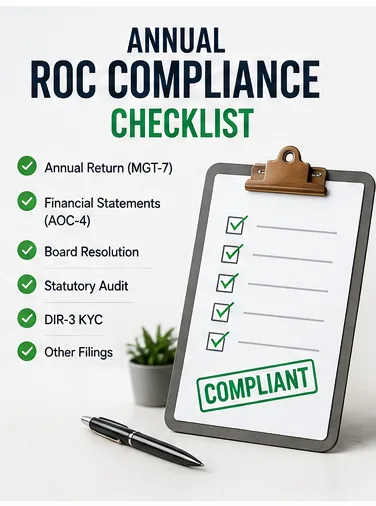
Annual compliance isn't one deadline — it's a sequence of them, each depending on the one before it. Here is the order that keeps everything on track.
Step 1: Hold Your AGM
Most companies must hold their Annual General Meeting by 30 September. Every other date on this list counts backward or forward from this one.
Step 2: File Form ADT-1 (Within 15 Days)
If your auditor was appointed or reappointed at the AGM, this intimation is due within 15 days — easy to forget because it's the first deadline, arriving before the bigger filings.
Step 3: File Form AOC-4 (Within 30 Days)
Your audited financial statements go to the Registrar within 30 days of the AGM. This is the financial half of annual compliance.
Step 4: File Form MGT-7 or MGT-7A (Within 60 Days)
The annual return — covering shareholding, director details and corporate structure — follows within 60 days of the AGM. Small companies and OPCs use the simplified MGT-7A.
Don't forget: DIR-3 KYC is separate and easy to miss
Every director's DIR-3 KYC is due by 30 September each year, regardless of the company's own AGM date. It's tied to the individual DIN, not the company — and missing it deactivates the DIN the very next day, which can stall every other filing above.
The single biggest cause of compliance backlogs we see is directors treating DIR-3 KYC as optional because it's "just a KYC update." It isn't optional, and its deadline doesn't move with your AGM.
We manage this entire sequence for clients on a fixed annual calendar — see our Annual ROC Filing and Director KYC services for the details.